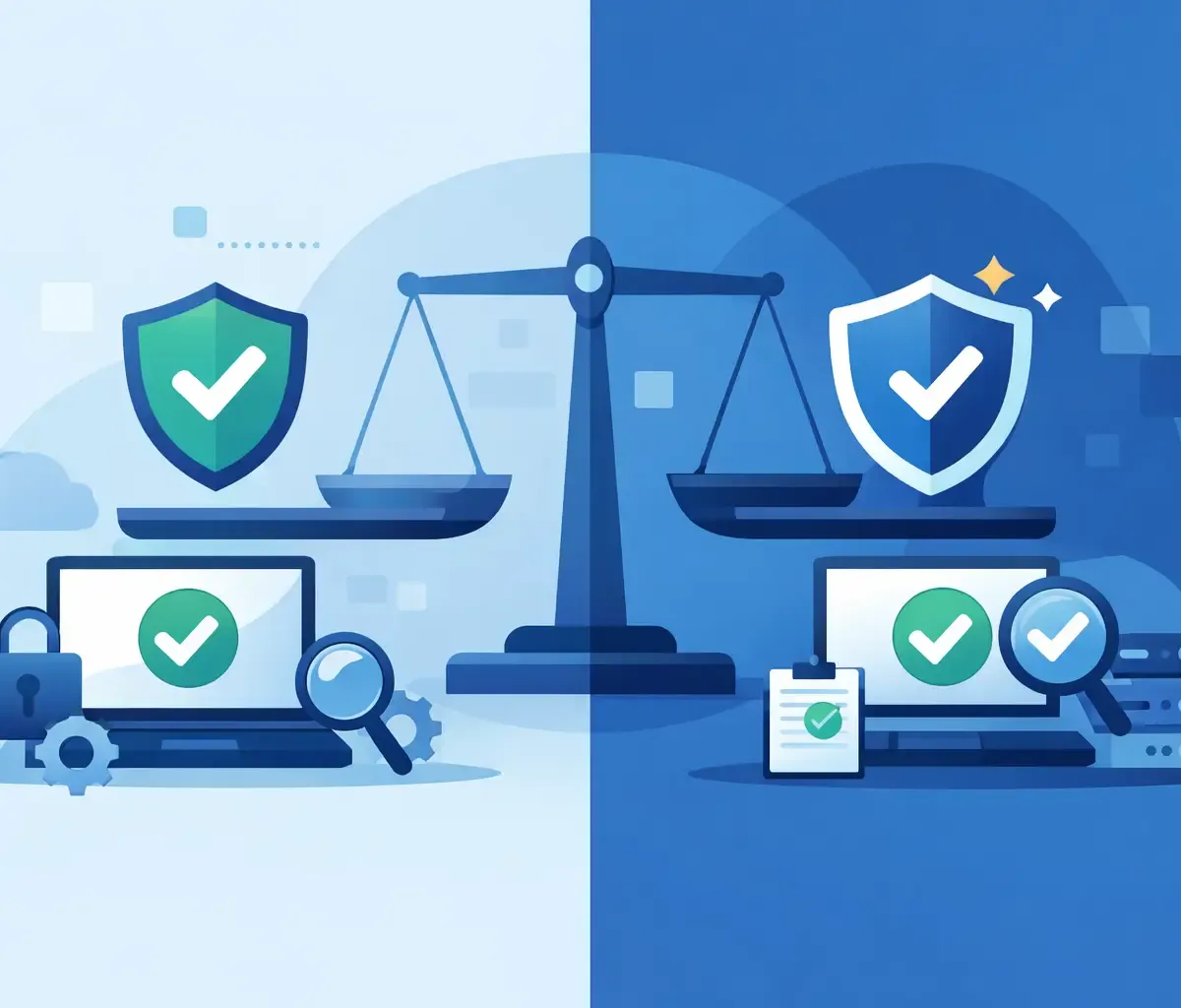
A customer asks for proof of Cyber Essentials, a tender makes certification mandatory, or the board wants a clearer view of cyber hygiene. The immediate question is usually Cyber Essentials vs CE Plus. The practical answer is not that one is universally better. Both address the same baseline controls. The difference is how confidently you need to demonstrate that those controls work in the real environment.
For organisations handling sensitive data, delivering public services or supporting critical business operations, that distinction matters. A certificate is useful. Independent evidence that controls have been tested is stronger - particularly when assurance must stand up to procurement scrutiny, insurance questions or an audit.
Cyber Essentials vs CE Plus: the core difference
Cyber Essentials is a UK government-backed certification scheme designed to reduce exposure to common cyber attacks. It focuses on a defined set of technical controls: boundary firewalls and internet gateways, secure configuration, access control, malware protection and security update management.
The standard Cyber Essentials assessment is based on a self-assessment questionnaire. An authorised certification body reviews the responses and, where needed, requests clarification or supporting information. Your organisation is responsible for accurately describing its systems, users, policies and technical settings.
Cyber Essentials Plus takes the same underlying requirements and adds independent technical verification. An assessor tests a sample of in-scope devices and user accounts, checks configuration, looks for missing security updates and carries out external vulnerability testing. It is designed to confirm that the controls declared in the questionnaire are actually operating.
That means CE Plus is not a separate, more advanced security framework. It is a higher-assurance assessment of the Cyber Essentials requirements. An organisation with mature controls but weak evidence may find the Plus process demanding. An organisation with clear ownership, accurate asset records and continuous configuration visibility will usually find it more predictable.
What each certification proves
Cyber Essentials demonstrates that an organisation has completed a reviewed self-assessment against the scheme’s requirements. For many smaller suppliers, this is the right level of assurance. It can meet a contractual requirement, provide a disciplined baseline for cyber hygiene and give management a defined set of actions to track.
Its limitation is inherent in the assessment model. The certification body is assessing the information supplied, rather than independently testing the operating environment in depth. If an unmanaged laptop, an overlooked cloud tenant or an unpatched server is absent from the evidence, the questionnaire may not reveal it.
CE Plus provides stronger confidence because the assessor validates a representative sample directly. The organisation still needs to complete Cyber Essentials first, but the Plus assessment tests whether devices are configured securely, whether patches are applied within the required timeframe, whether accounts are properly controlled and whether common vulnerabilities are externally exposed.
For a buyer, insurer or regulator, this is a material distinction. CE Plus does not guarantee that an organisation will not suffer a cyber incident. No certification can do that. It does, however, reduce reliance on stated intent and replaces part of it with independent evidence.
When Cyber Essentials is the sensible choice
Standard Cyber Essentials is often the appropriate starting point when a business needs to satisfy a supplier condition, establish a manageable security baseline or prepare for a more rigorous programme later. It is also suitable where the technology estate is relatively simple and the organisation can confidently account for every device, account and internet-facing service in scope.
The questionnaire can be valuable in its own right. It forces decisions on subjects that are often left vague: who has administrative access, how quickly updates are deployed, whether unsupported software remains in use, and which devices are permitted to connect to corporate services.
However, organisations should not treat it as a paperwork exercise. The most common source of difficulty is not a difficult question. It is uncertainty over the estate. If IT teams cannot confirm what is connected, which operating systems are in use or where privileged access exists, they cannot give leadership answers they can trust.
For MSPs and MSSPs, standard Cyber Essentials can also form a useful entry-level managed service. The commercial opportunity is strongest when it becomes a recurring assurance process rather than a once-a-year questionnaire completed under pressure.
When CE Plus is worth the additional effort
CE Plus is usually the stronger option where a contract specifically requires it, where the organisation operates in a regulated or high-consequence sector, or where customer confidence depends on independently verified cyber controls. Public-sector supply chains, organisations handling significant personal or financial data, and businesses with complex hybrid infrastructure often fall into this category.
It is also worth considering after a significant technology change. A move to Microsoft 365, Azure, AWS, Intune, Kubernetes or a new managed endpoint platform can alter the security posture quickly. CE Plus creates a clear deadline for validating that intended settings are in place across the estate, not merely in a project plan.
The trade-off is preparation. External testing can identify issues that internal teams have accepted as temporary, such as a device awaiting replacement, an old administrator account or an endpoint that missed a patch cycle. These findings are not a reason to avoid CE Plus. They are the reason the independent assessment has value. But organisations should allow time to remediate before booking the assessment.
The real decision is evidence, not badge value
The wrong way to compare Cyber Essentials and CE Plus is to ask which certificate looks better on a website. The better question is: what level of evidence do customers, regulators, insurers and leadership need from us?
If the requirement is simply to show that baseline controls have been assessed, Cyber Essentials may be sufficient. If you need to demonstrate that those controls work across live systems, CE Plus is the more credible route. The premium is not only for testing. It is for the ability to answer a harder question: can we prove this is true in practice?
Cost should be considered in the same way. The direct certification fee is only one part of the decision. Internal time spent identifying assets, resolving configuration exceptions, chasing patch status and collecting screenshots can easily outweigh it. A lower-cost certification path becomes expensive when the evidence process is manual and repeated every year.
Preparing without creating a last-minute audit project
Successful certification starts with scope and visibility. Before completing a questionnaire or engaging a CE Plus assessor, establish what is included: corporate endpoints, servers, cloud services, user accounts, network equipment and internet-facing systems. The exact assessment scope should be agreed with the certification body, particularly where subsidiaries, home workers or managed services are involved.
Next, test the basic questions internally. Can you identify unsupported operating systems and software? Can you see devices that have not received required security updates? Can you distinguish standard users from administrators? Can you confirm that unnecessary services, weak configurations and default credentials have been addressed?
This is where fragmented tools create avoidable work. One team may hold endpoint data, another manages identity, and a third owns cloud configuration. Evidence then has to be assembled manually, often just before renewal. A unified view of assets, identities, vulnerabilities and service ownership turns certification from an annual scramble into a continuous assurance activity.
Rebasoft supports that approach by helping teams understand what is connected, what is exposed and what needs fixing first in business-service context. The objective is not to produce more alerts. It is to produce defensible evidence and faster remediation decisions.
Do not mistake a passed assessment for continuous control
Both certifications are valid for a defined period, but your estate changes every week. New devices appear, accounts gain privileges, software reaches end of support and cloud settings drift. A passed assessment is a point-in-time confirmation, not permanent proof of good practice.
The organisations that gain the most value from Cyber Essentials or CE Plus use the requirements as operating controls. They assign owners, monitor exceptions, retain evidence and review changes that could affect compliance. That approach reduces cyber risk between certification dates and makes renewal far less disruptive.
Choose Cyber Essentials when a reviewed baseline is proportionate to your risk and customer obligations. Choose CE Plus when independent testing will materially strengthen trust. Then build the visibility to keep those controls true long after the certificate is issued.