A critical vulnerability on an unmanaged asset is not a patching problem. It is a visibility problem first, a prioritisation problem second, and only then a remediation task. That is why the vulnerability management lifecycle matters. If your teams cannot see what is connected, understand what supports a business service, and prove what was fixed, they are left reacting to noise rather than reducing cyber risk.
For most organisations, the challenge is not a lack of alerts. It is too many disconnected alerts from too many tools, with too little business context. Security teams get technical findings. IT operations get tickets. Leadership gets a risk register that often arrives late and without enough evidence behind it. A well-run lifecycle closes those gaps. It turns vulnerability management from a periodic scan-and-patch exercise into an operational discipline that improves resilience, audit readiness, and decision-making.
What the vulnerability management lifecycle really means
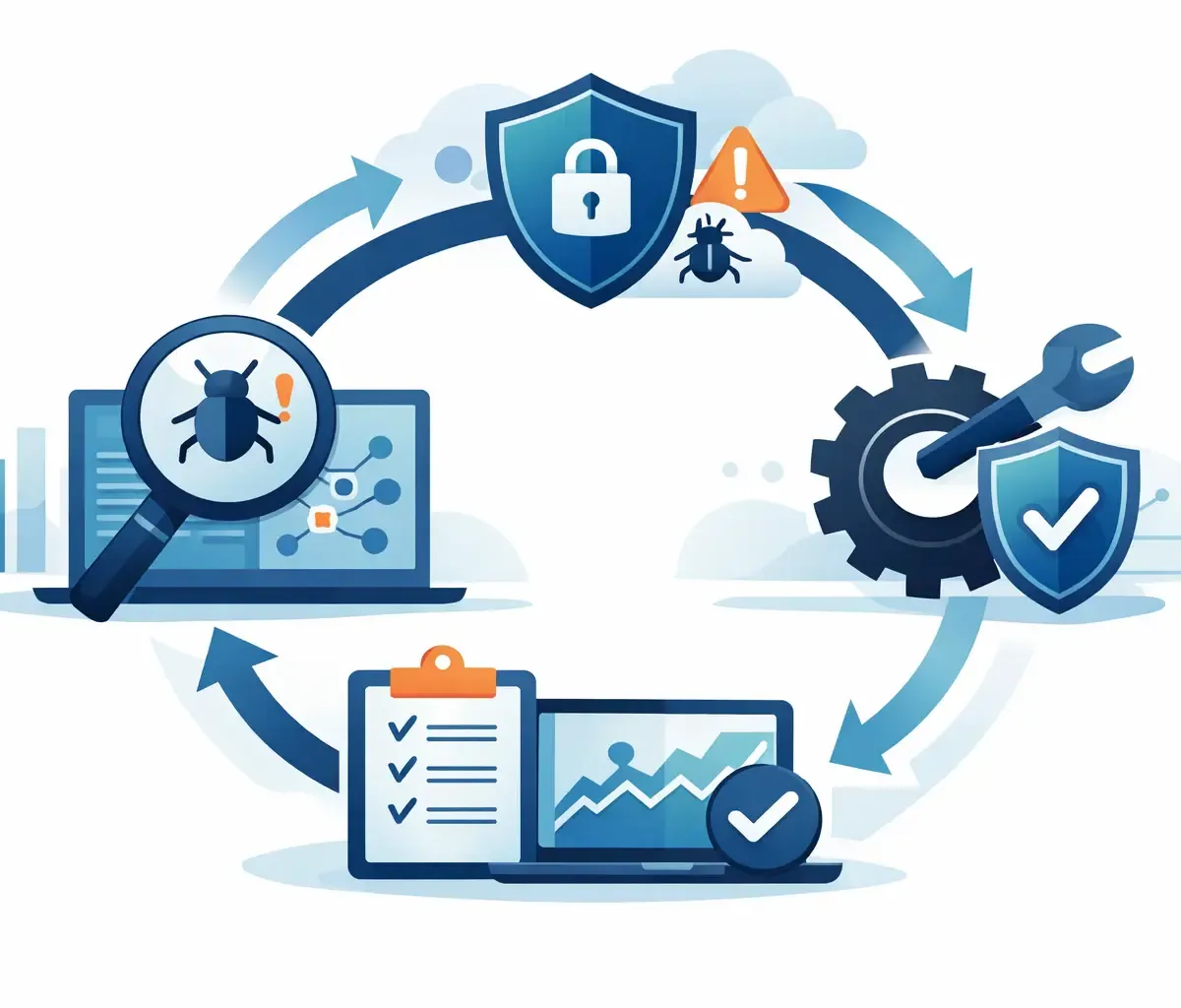
The vulnerability management lifecycle is the continuous process of finding exposures, understanding their relevance, deciding what matters most, fixing what needs fixing, and validating the outcome. It is not a one-off project and it is not just about CVEs. Weak configurations, unsupported systems, identity exposure, internet-facing services, and control failures all influence the real level of risk.
This is where many programmes stall. They treat every vulnerability as if it carries equal weight. In practice, it depends on the asset, the user, the service, the route to exploitation, and the operational consequences if something goes wrong. A medium-severity issue on a domain controller or clinical service may deserve faster action than a high-severity issue on an isolated test machine.
A useful lifecycle gives operational teams clear direction and gives leadership answers they can trust. It should show what is exposed, what is affected, what should be fixed first, and whether the organisation is actually becoming safer over time.
The core stages of the vulnerability management lifecycle
1. Discovery comes before assessment
You cannot manage risk on assets you do not know exist. Yet unknown assets remain one of the most common reasons vulnerability programmes underperform. Cloud workloads appear and disappear. Devices move between networks. Shadow IT bypasses formal onboarding. Third-party services are introduced with minimal visibility.
This makes discovery the foundation of the lifecycle. The goal is to identify assets, services, identities, and dependencies continuously, not just during scheduled scans. If your asset inventory is incomplete, every subsequent stage is compromised. Findings will be partial, remediation plans will miss systems, and reporting will create a false sense of assurance.
For regulated organisations and public-sector teams, this is not just a technical weakness. It creates governance risk. If you cannot show what is in scope, it becomes much harder to demonstrate control to auditors, insurers, or senior stakeholders.
2. Assessment must reflect real exposure
Once assets are visible, the next stage is to assess vulnerabilities and control weaknesses. Traditional programmes often rely heavily on periodic scanning. That can still play a role, but it has limits. Scans can miss transient assets, create operational friction, and produce volumes of findings without enough context to support rapid action.
What matters is not simply whether a vulnerability exists, but whether it is present on a live asset, tied to a critical service, reachable, exploitable, or compensatingly controlled. This is where continuous evidence is more valuable than isolated snapshots. Security leaders need to understand not just the vulnerability itself, but the surrounding conditions that make it significant.
A good assessment stage also widens the lens. Patchable software flaws are only part of the picture. Misconfigurations, stale accounts, weak privileges, unsupported operating systems, exposed management interfaces, and policy drift can create equivalent or greater risk.
3. Prioritisation is where value is won or lost
Most vulnerability backlogs do not fail because teams are unwilling to fix issues. They fail because there is no credible way to decide what should be fixed first. CVSS alone is not enough. Nor is exploitability data on its own.
Prioritisation has to combine technical severity with business context. Which assets support revenue, patient care, operations, or regulated data? Which exposures are linked to privileged users? Which weaknesses affect systems that cannot tolerate downtime? Which issues are repeatedly reintroduced and point to a process problem rather than a one-off incident?
This stage is where mature organisations separate signal from noise. Instead of assigning the same urgency to hundreds of findings, they focus effort where remediation will reduce the most risk. That improves time to value and prevents security teams from burning credibility with over-escalation.
For MSPs and MSSPs, prioritisation also affects service quality. Customers do not want another dashboard full of raw alerts. They want clear, defensible action tied to business outcomes.
Why remediation often breaks down
Ownership is usually the issue
Remediation sounds straightforward until you try to run it across infrastructure, cloud, identity, applications, and third parties. Then the same questions appear every time. Who owns the affected asset? Who has authority to change it? What is the maintenance window? What service could be disrupted? Is there a workaround if patching is not possible?
This is why the lifecycle must connect findings to accountable owners and business services. Without that, security teams end up raising issues that nobody can action quickly. The result is delay, friction, and a growing backlog of accepted risk that may not have been properly assessed.
Not every fix is a patch
Another common weakness is assuming remediation always means applying an update. Sometimes it does. Sometimes the better response is to disable a service, remove local admin rights, isolate an exposed system, tighten a configuration baseline, or retire an obsolete asset altogether.
There are trade-offs here. In operational technology, healthcare, manufacturing, and legacy-heavy estates, immediate patching may not be realistic. The right question is not always, can we patch now? It may be, how do we reduce risk quickly while protecting service continuity? Mature teams plan for both primary fixes and compensating controls.
Validation turns activity into assurance
A ticket marked closed is not proof that risk has been removed. Validation is the stage that confirms whether remediation happened, whether it worked, and whether anything else changed as a result. This matters because many organisations report progress based on workflow status rather than technical evidence.
Validation should answer three practical questions. Is the vulnerability no longer present? Is the control now operating as intended? Has the overall exposure to the business service been reduced? If the answer to any of these is unclear, leadership is being asked to trust process rather than evidence.
This is also the point where reporting becomes meaningful. Board-level reporting should not be a long list of technical findings. It should show trends in exposure, remediation performance, exceptions, control effectiveness, and risk reduction against critical services. That gives leadership a basis for decisions on budget, insurance posture, operational risk, and compliance.
How to make the vulnerability management lifecycle work in practice
The organisations that get this right tend to do three things consistently. First, they build the lifecycle on continuous visibility rather than periodic snapshots. Second, they prioritise in business-service terms, not just technical severity. Third, they use evidence to prove outcomes, not just effort.
That often means reducing tool fragmentation. When asset intelligence, vulnerability context, control validation, identity visibility, and reporting sit in separate systems, teams spend too much time stitching data together and arguing over accuracy. Consolidation is not only a cost decision. It is a speed and assurance decision.
This is also where an agentless, scanless approach can change the economics of the programme. It lowers deployment friction, expands coverage across complex estates, and supports continuous insight without adding more operational burden. For organisations trying to improve assurance quickly, that can be the difference between another dashboard project and a working operating model. Rebasoft is built around that principle.
What good looks like
A mature vulnerability programme does not promise zero vulnerabilities. That is not credible in modern estates. What it does promise is control. You know what you have. You know what is exposed. You know what matters most. You can show what was fixed, what remains at risk, and why.
That level of clarity helps operational teams act faster and helps leadership make better decisions. It also supports audit effort, compliance evidence, and cyber insurance readiness because the organisation is not relying on assumptions or manual spreadsheets to explain its position.
The best time to improve the vulnerability management lifecycle is before the next serious finding tests it. If visibility is partial, ownership is unclear, and reporting depends on manual interpretation, the weaknesses are already there. Fixing the lifecycle is not administrative tidy-up. It is how you reduce cyber risk with confidence and give leadership answers they can trust.
The useful question is not whether your organisation has a vulnerability process. Most do. The real question is whether that process produces evidence, prioritisation, and outcomes strong enough to stand up under pressure.